How a project is procured shapes how it should be estimated. This guide surveys the major delivery methodologies used globally. ConstrCalc is compatible with all of them — you enter the values, ConstrCalc does the math.
Design-Bid-Build (DBB)
The traditional method. Owner commissions an architect for full plans, then invites contractors to bid competitively. Lowest responsive bidder typically wins. Best for clearly defined scopes, weakest for schedule pressure.
Design-Build (DB)
Owner contracts a single entity for both design and construction. Faster than DBB, better cost certainty early, but less design flexibility once contracted. Common for warehouses, standardized commercial, some residential.
Construction Management at Risk (CMAR)
Owner hires a construction manager during design to advise on constructability and cost. The CM then delivers the project under a Guaranteed Maximum Price (GMP). Common for large commercial, healthcare, education projects.
Turnkey
Contractor delivers a fully finished, immediately usable project — design, build, finishes, and often furniture. Owner writes one cheque. Common for factories, franchise buildouts, some hospitality projects.
Public-Private Partnership (PPP / P3)
Private partner finances, designs, builds, and often operates a public asset for a concession period. Used for highways, bridges, hospitals, airports globally.
Each methodology changes what goes into your Overhead, Profit, and contingency lines. ConstrCalc does not enforce a choice — enter your numbers based on your contract.
How Method Choice Drives Cost
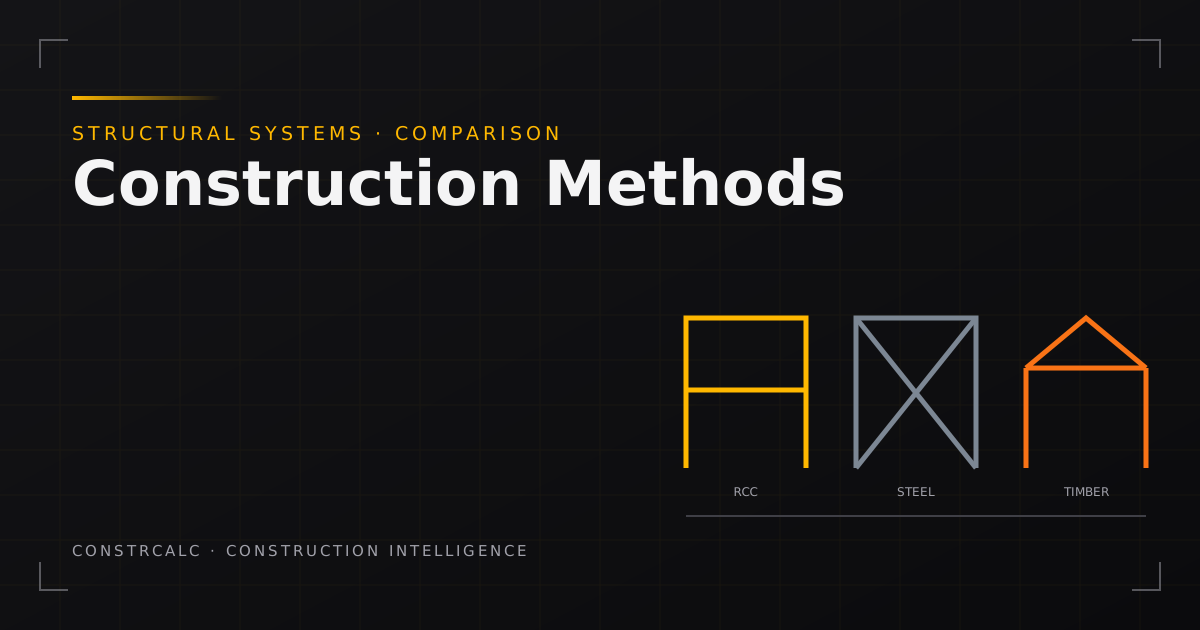
The structural system chosen for a building determines far more of its cost profile than the floor area does. Reinforced concrete framing concentrates spend in cement, aggregate, reinforcement and formwork, and in the wet-trade labour that places them. Steel framing shifts cost toward fabricated sections, connections and erection plant, while compressing programme duration. Light timber framing reduces material cost substantially in markets where timber is readily available, but depends on a skilled carpentry trade and appropriate climate and code conditions.
Comparing two methods on cost alone is therefore misleading unless the comparison also accounts for programme length, plant requirements, site constraints and the availability of the relevant trades locally.
Programme and Plant Implications
Wet trades impose curing times that cannot be compressed by adding labour. Concrete gains strength on its own schedule, and pour sequencing constrains everything above it. Prefabricated and steel systems trade that constraint for a different one: lead times on fabrication, and crane availability during erection. Neither is inherently faster — the advantage depends on which constraint dominates on the specific site.
Choosing Appropriately
- Local trade availability usually matters more than theoretical efficiency. A method your local workforce does not routinely build will cost more and carry more risk, whatever the textbook says.
- Site access constrains plant. Restricted urban sites may rule out the crane a steel frame needs.
- Climate affects curing, weather delays and material performance over the building's life.
- Code requirements differ by system and jurisdiction, and can add design and approval time.
When comparing options, model each one as a separate estimate and put them side by side in Compare Estimates rather than adjusting a single estimate with a factor. Factored comparisons hide exactly the differences that matter.