
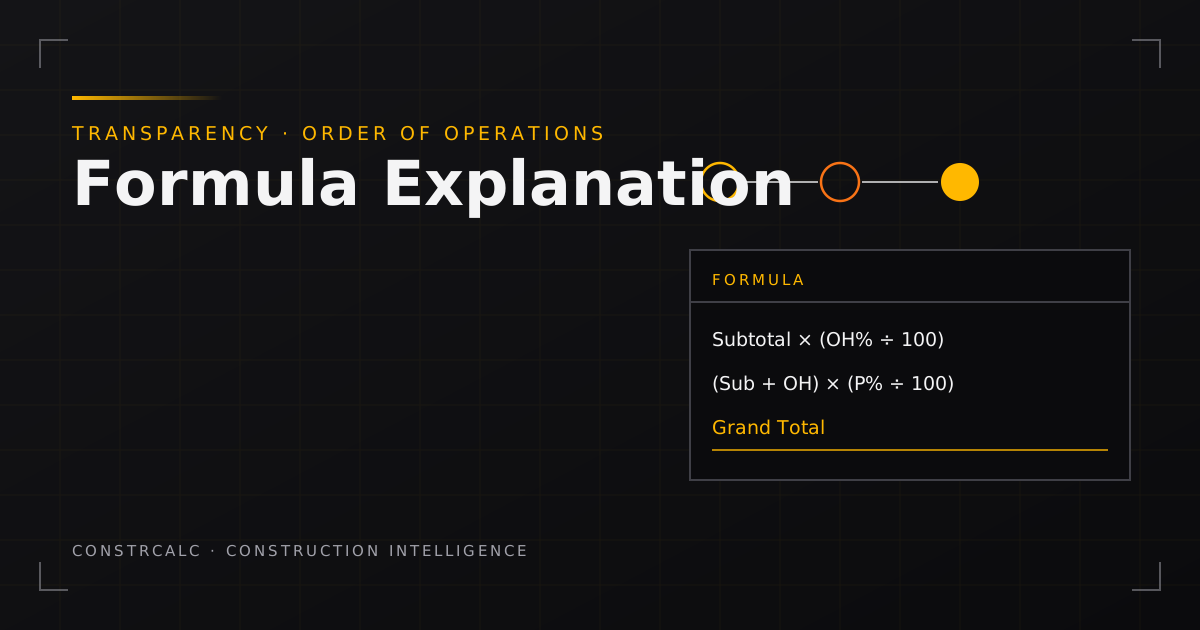
ConstrCalc uses a small, transparent set of formulas. Every result the calculator produces is derived from these — no additional multipliers, no seasonal factors, no AI predictions.
Cost Chain
Subtotal   = Materials + Labor + Equipment + Legal
Overhead   = Subtotal × (Overhead% ÷ 100)
Profit     = (Subtotal + Overhead) × (Profit% ÷ 100)
Grand Total = Subtotal + Overhead + Profit + Taxes
Worked Example
Materials $10,000 · Labor $8,000 · Equipment $2,000 · Legal $1,000 · Overhead 15% · Profit 10%.
- Subtotal = 10,000 + 8,000 + 2,000 + 1,000 = $21,000
- Overhead = 21,000 × 0.15 = $3,150
- Profit = (21,000 + 3,150) × 0.10 = 24,150 × 0.10 = $2,415
- Grand Total = 21,000 + 3,150 + 2,415 = $26,565
Per-Unit Metrics
Cost per ft²   = Grand Total ÷ area (in ft²)
Cost per m²    = Grand Total ÷ area (in m²)
Cost per Floor = Grand Total ÷ number of floors
Cost per Month = Grand Total ÷ project duration in months
These are derivations, not predictions. They tell you your unit rate — they do not forecast anyone else's.
Why the Order of Operations Matters
Overhead and profit are applied in sequence, not added together as a single percentage. Overhead is calculated on the subtotal; profit is then calculated on the subtotal plus overhead. The distinction is not academic. On a $100,000 subtotal, 15% overhead followed by 10% profit produces $126,500 — not the $125,000 that a flat 25% would suggest. Applied across a year of work, that gap is the difference between a comfortable margin and a marginal one.
Markup and Margin Are Not the Same
Markup is a percentage added to cost. Margin is profit expressed as a percentage of the final price. A 25% markup on cost yields a 20% margin on price. Quoting on one basis while thinking in the other is a reliable way to under-price work, and it is a common source of disagreement between estimators and business owners reading the same figures.
Transparency as an Estimating Discipline
Every figure the calculator produces is derived from values you entered, using formulas published in the Formula Library. Nothing is inferred, adjusted or silently corrected. That is a deliberate constraint rather than a limitation: an estimate you cannot audit is an estimate you cannot defend, and a client who can see how a number was built is far more likely to accept it.
The practical consequence is that the quality of the output depends entirely on the quality of the inputs. Rates should be burdened, quantities should be measured, and assumptions should be written down alongside the estimate rather than carried in someone's head.