A construction estimate is only as complete as the categories it accounts for. This guide lists the major cost buckets used by professional estimators. It does not predict costs, prescribe multipliers, or auto-fill any field in the ConstrCalc® calculator. Enter your own values based on quotes you obtain locally.
Direct Costs
- Materials — cement, sand, aggregate, steel, bricks, timber, glass, paint, finish materials. Purchased at unit prices from suppliers.
- Labor — general labor + skilled labor (electricians, plumbers, carpenters). Tracked by hours or days at prevailing local rates.
- Equipment Rental — heavy equipment (excavator, crane, concrete mixer) and small tools. Priced by day or week.
- Legal / Professional — permits, architect fees, engineer fees, site surveys, inspections, insurance.
Indirect Costs
- Overhead — business operating costs distributed across projects (office rent, admin, insurance, marketing). Applied as a % of direct-cost subtotal.
- Profit — contractor's margin. Applied on (Subtotal + Overhead) in the ConstrCalc formula.
- Taxes — VAT / GST / sales tax on materials or the total invoice, per local jurisdiction.
Formula Chain (ConstrCalc)
Subtotal   = Materials + Labor + Equipment + Legal
Overhead   = Subtotal × Overhead%
Profit     = (Subtotal + Overhead) × Profit%
Grand Total = Subtotal + Overhead + Profit + Taxes (when applied)
Every number in the output derives from a number you entered. There are no hidden multipliers.
What a Cost per Unit Area Actually Tells You
Cost per square foot or square metre is the most quoted and most misunderstood figure in construction. It is a comparison rate, useful for benchmarking a project against completed buildings of similar type, specification and location. It is not a pricing method. Two buildings of identical floor area can differ by a factor of three once specification, structural system, site conditions and finish level are accounted for.
Used properly, the rate is a sanity check applied after a detailed estimate, not a shortcut used instead of one. If your measured build-up produces a rate far outside the range for comparable local projects, that is a signal to re-examine the estimate — not a reason to overwrite it.
The Anatomy of a Construction Estimate
A defensible estimate separates costs by behaviour, not merely by trade:
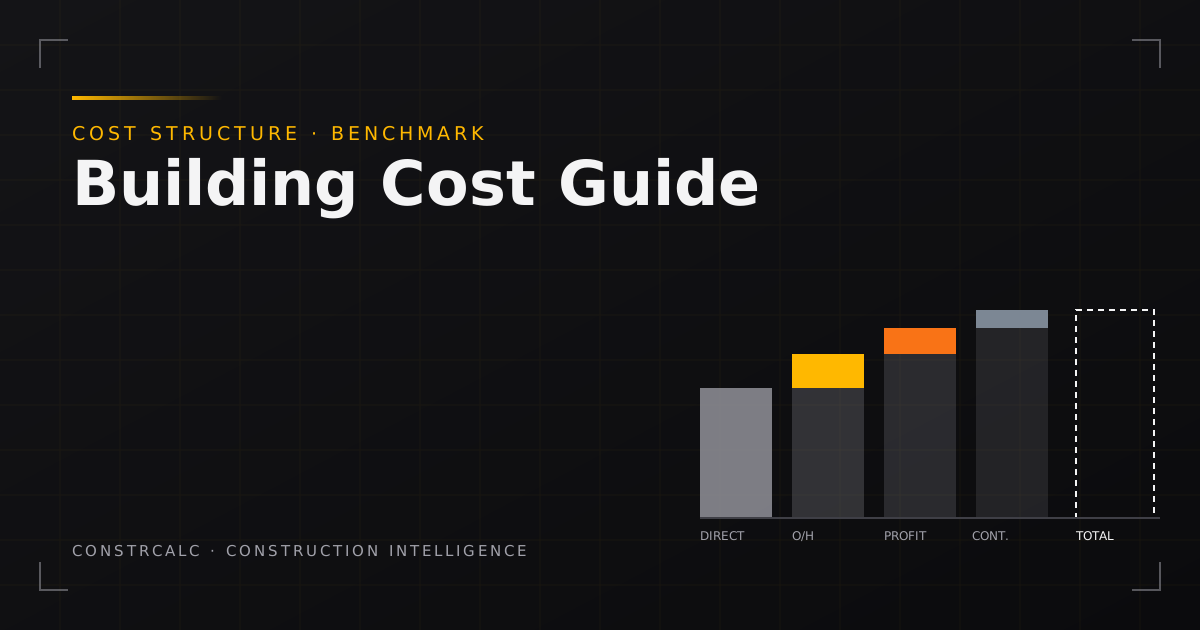
- Direct costs attach to the physical work: materials, labour, plant and subcontracted packages.
- Indirect costs support the work without forming part of it: site setup, temporary services, waste disposal, permits and professional fees.
- Overhead recovers the cost of running the business across all projects.
- Profit is the return for risk and capital, applied after overhead.
- Contingency covers uncertainty within the defined scope, and is disclosed rather than hidden.
Estimates that collapse these into a single rate become impossible to audit, and impossible to defend when a client questions a number.
Where Estimates Usually Go Wrong
In practice the failures cluster. Indirect costs get forgotten because they do not appear on any drawing. Contingency gets buried in inflated unit rates rather than shown as a line, which clients resent when they discover it. Overhead percentages get inherited from a rule of thumb instead of derived from the contractor's own accounts. And labour is priced on the bare wage rather than a burdened rate that includes taxes, insurance and statutory benefits.
Each of these is individually small. Together they routinely account for the difference between a job that looked profitable at tender and one that was not.
Benchmarking Responsibly
Published cost ranges are orientation, not authority. They age quickly, rarely disclose their specification assumptions, and almost never match your local labour market. The most reliable benchmark any contractor has is their own completed-project history: actual costs, reconciled against what was estimated, for buildings they actually built. Keeping that record is unglamorous and worth more than any published table.