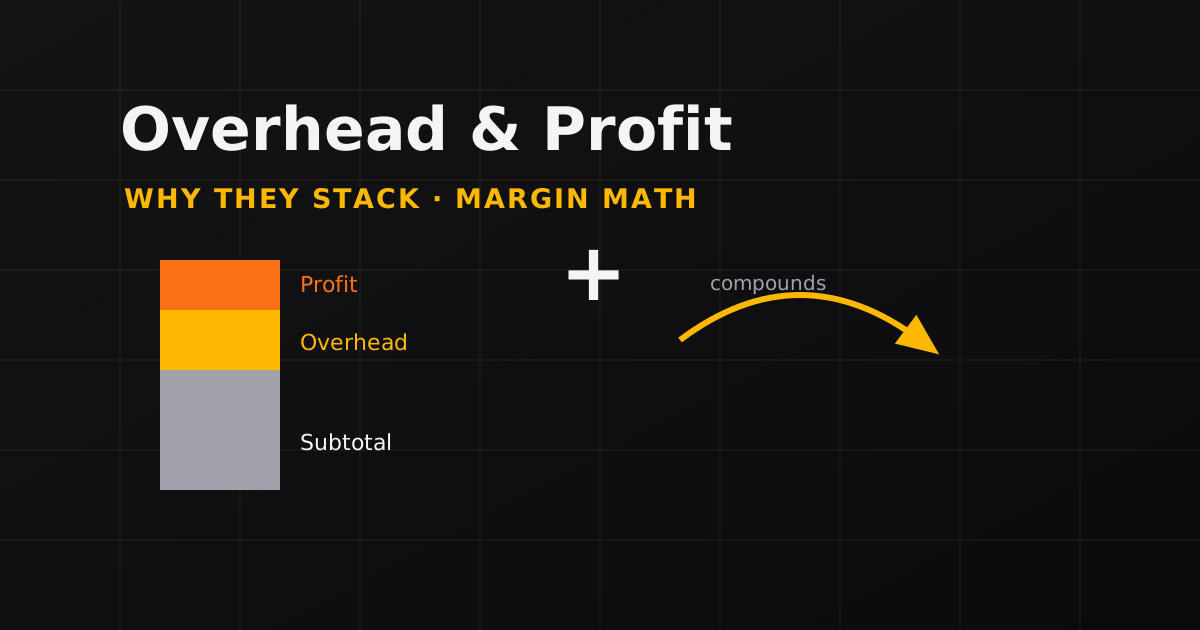
Overhead and profit sound similar, get abbreviated together as “O&P,” and are constantly confused — which is expensive, because they are fundamentally different things that combine in a way most people get slightly wrong. Overhead is a cost you must recover to stay in business. Profit is the reward you earn for taking the job on. Treat them as interchangeable, or add them as if they were flat, and you will consistently under-price your work by a few percent — the exact few percent that separates a healthy contractor from one that is quietly running down its reserves.
This guide separates the two cleanly, shows the formulas that stack them in the right order, and gives you a sensible way to set the percentages for your own business.
Overhead: the cost of being in business
Overhead covers everything it takes to operate your company that isn’t tied to a single project: office or yard rent, business insurance, administrative salaries, accounting and legal, marketing, software, vehicle payments, and the small tools that follow you from job to job. None of it appears in the drawings, but all of it has to be paid — so it is recovered by loading a percentage onto the direct cost of every project.
Formula: Overhead = Subtotal × (Overhead % ÷ 100)
Typical range: 10–25%. Solo remodelers with minimal fixed costs often land at 10–15%; general contractors carrying an office and staff more commonly sit at 15–25%.
Profit: the reward for risk
Profit is what remains once every cost, including overhead, has been covered. It is not a cost — it is the return for the capital you put at risk, the complexity you manage, and the opportunity cost of not deploying your resources elsewhere. A business that merely covers its costs has no buffer for the bad job, no fuel for growth, and no reward for the risk it carries.
Formula: Profit = (Subtotal + Overhead) × (Profit % ÷ 100)
Read that formula carefully: profit is calculated on the subtotal plus overhead, not on the subtotal alone. That is deliberate, and it is where the compounding lives.
Why they compound — the number that surprises people
Because profit is applied after overhead, the two markups stack rather than add. Work an example on a $100,000 subtotal with 15% overhead and 10% profit:
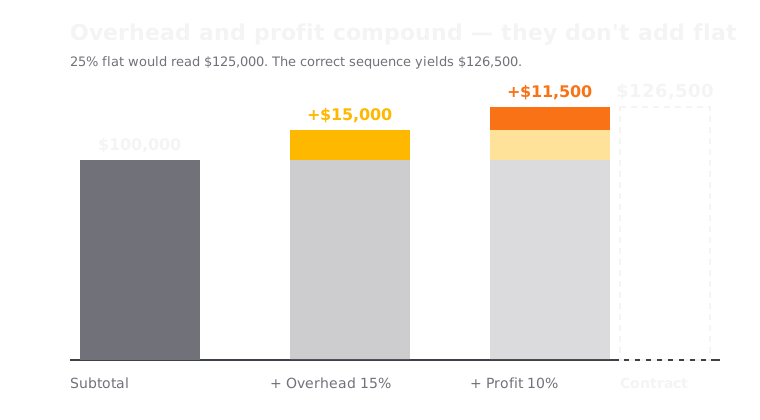
Overhead adds $100,000 × 15% = $15,000, giving $115,000. Profit is then $115,000 × 10% = $11,500, giving $126,500. A flat 25% on $100,000 would read $125,000 — $1,500 short. On a single job that is a rounding error; across a year of work it is the difference between comfortable and marginal. Compound math matters, and the sequence — overhead first, profit on the combined base — is the whole point.
Construction planning insights
- Recover overhead honestly. If your overhead percentage is guessed rather than derived from your accounts, you are either pricing yourself out of work or slowly going broke. Total your annual fixed costs, divide by expected annual revenue, and use the real number.
- Set profit by risk, not habit. A complex, fast-track or high-liability job earns a higher profit target than a simple, familiar one. Flat profit across a varied portfolio leaves money on the table on the hard jobs.
- Protect the sequence. Apply overhead to the subtotal, then profit to the combined base. Reversing or flattening the order quietly changes your margin.
Markup versus margin — a common trap
One more distinction saves a lot of pain: markup and margin are not the same. Markup is a percentage added to cost; margin is profit as a percentage of price. A 25% markup on cost is only a 20% margin on price. Decide which basis you are quoting on and stay consistent, because confusing the two is another reliable way to under-price. The Formula Library documents the Overhead, Profit and Grand Total build-up exactly as ConstrCalc applies them.
Global construction standards
The overhead-then-profit sequence is standard practice across international estimating and is reflected in widely used cost frameworks and standard methods of measurement. What varies is the level: local labor markets, competition, business structure and tax regime all move the percentages. Treat published O&P ranges as orientation, then calibrate to your own audited figures — a percentage that keeps one contractor solvent can bankrupt another in a different market. The Knowledge Center Building Cost Guide and Country Guides add regional colour.
Professional tips
- Derive overhead from your books. Annual fixed costs ÷ expected revenue = your real overhead rate. Update it yearly.
- Vary profit deliberately. Keep a small rubric — job complexity, risk, client, schedule pressure — and adjust the profit target against it.
- Quote on a consistent basis. Pick markup or margin and never mix them within an estimate.
- Show O&P as its own line where appropriate. Transparency builds trust and makes negotiations about scope, not about your integrity.
Frequently asked questions
What is the difference between overhead and profit?
Overhead is the cost of running your business, recovered across projects. Profit is what remains after all costs, including overhead, are covered — the return for risk, capital and complexity. One is a cost to recover; the other is a target to earn.
Do overhead and profit add or compound?
They compound. Overhead applies to the subtotal; profit then applies to subtotal plus overhead. On $100,000 at 15% and 10%, the result is $126,500, not the $125,000 a flat 25% implies.
What are typical percentages?
Overhead commonly runs 10–25% by business size; profit targets are set by risk and market. Calibrate both to your own accounts rather than borrowing a rule of thumb.
Conclusion
Overhead keeps the lights on; profit is why you took the risk. Recover overhead from real numbers, set profit by the risk of the job, and always apply them in sequence so the compounding works for you rather than against you. Master that, and the least glamorous part of your estimate becomes the part that keeps your business alive.
Stack overhead and profit correctly
Set your percentages once — ConstrCalc applies them in the right order, every time.
Related articles
- 7 Hidden Costs That Sink Construction Bids
- Labor Cost: Hourly vs Daily
- PDF vs Excel: When to Use Which Export
Related calculators & tools
- Construction Cost Calculator — set overhead and profit and see the grand total build up.
- Compare Estimates — test different margin scenarios side by side.
- Popular Calculators