
Labor is the most volatile line in almost every construction estimate. Material prices move, but crews move faster: productivity swings with weather, sequencing, supervision and morale, and a single choice on your rate sheet — hourly or daily — quietly shapes how well your estimate survives contact with the site. The choice looks trivial. It is not. Get it wrong and you either leave money on the table or bid a job you cannot deliver profitably.
This guide walks through when each model fits, the crew-cost formula that sits underneath both, and the one calculation mistake that inflates more labor estimates than any other.
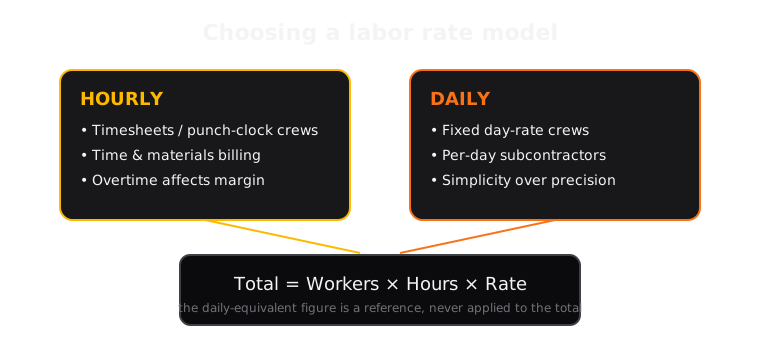
Use hourly rates when…
- Your crew records time by timesheet or punch-clock, so hours are a number you actually have.
- You bill time and materials (T&M) with an hourly overhead loading.
- Overtime rules apply and materially affect your margin — hourly is the only model that captures the premium honestly.
- Tasks are short, variable, or interrupt-driven, where a full day-rate would overstate the work.
Use daily rates when…
- Crews are paid a fixed day-rate regardless of the exact hours worked.
- You subcontract and the subcontractor bills per day.
- Simplicity beats precision — small residential remodels where hour-by-hour tracking adds cost without adding accuracy.
- Work is naturally organised in full-day blocks, such as a pour or a fixed erection sequence.
The crew-cost formula behind both
Whichever rate you quote, the arithmetic that produces the labor total is the same. Construction labor cost is a product of headcount, time and rate:
Labor Cost = Workers × Hours × Hourly Rate
A daily rate is simply this formula with the hours fixed to a standard shift. The figure ConstrCalc shows as “Daily Rate (Equivalent)” beside an hourly input is exactly that: Hourly × 8, offered as a reference so you can compare a quoted day-rate against your hourly build-up. It is a cross-check, not an input to the total.
The daily-equivalent trap
Here is the mistake that inflates estimates: an estimator enters an hourly rate, sees the daily-equivalent reference, and then also multiplies by a day-rate somewhere downstream — double-counting the shift. The rule is simple and worth stating on your rate sheet: the total is always Workers × Hours × Hourly Rate. The daily equivalent exists only to help you sanity-check a subcontractor’s quoted day-rate against your own hourly build-up. If the two disagree sharply, one of your assumptions is wrong — investigate before you bid.
Construction planning insights
A rate is only half the labor estimate; the other half is productivity — how much work a crew completes per hour. Two crews at the same rate can differ 30% in output. Build productivity into your plan explicitly:
- Estimate in crew-hours, then price. Work out how many crew-hours a task needs from output rates, then apply the labor formula. This separates “how long” from “how much,” which makes both easier to defend.
- Account for non-productive time. Set-up, moves, weather delays and rework are real. A crew rarely delivers eight fully productive hours in an eight-hour shift.
- Watch the overtime cliff. Overtime raises the rate and usually lowers productivity at the same time — a double hit that daily rates hide entirely.
Formula in practice: burdened rates
The base wage is not the cost of labor. A defensible estimate uses a fully burdened rate that adds employer costs on top of the wage:
Burdened Rate = Base Wage × (1 + Burden %)
Burden typically covers payroll taxes, insurance (including workers’ compensation), statutory benefits and sometimes small tools and supervision. Depending on jurisdiction, burden commonly adds 20–40% to the base wage. Feed the burdened rate into the crew-cost formula, and the labor total in your estimate reflects what the crew truly costs you — not just what lands in their pay packet. The related cost build-up is documented in the Formula Library, including how labor rolls into the subtotal.
Global construction standards
Labor conventions are strongly regional, so confirm the local basis before you apply any rate:
- North America & Europe. Hourly rates dominate, frequently governed by prevailing-wage rules, union agreements or collective bargaining. Overtime multipliers are defined by statute.
- South Asia, the Middle East & Africa. Daily wage (the “day-rate”) is common for general labor, with skilled trades often priced per day or per unit of output.
- Piece-rate and sub-contract. In many markets, finishing trades are priced per unit — per square metre of plaster, per door hung — which is neither hourly nor daily and should be estimated on its own basis.
Currency and working-week conventions differ too; ConstrCalc supports 40+ currencies so the model travels with you. For the wider planning context, see the Knowledge Center Planning Guide.
Professional tips
- Pick one model per line and label it. Mixing hourly and daily within a single crew line is where double-counting creeps in.
- Always burden the rate. If your labor rate equals the wage, your estimate is already low.
- Keep historical output rates. Your own crew-hour productivity from past jobs beats any published table.
- Stress-test overtime. Run the estimate with and without overtime so you can see the margin exposure before you sign.
Frequently asked questions
Should I estimate labor by the hour or by the day?
Hourly when you track time, bill T&M, or are exposed to overtime. Daily when crews are paid a fixed day-rate, you subcontract per day, or simplicity matters on a small job. Both resolve to the same crew-cost formula.
What is the daily-equivalent trap?
The daily-equivalent figure is a reference for comparison only and must never be applied to the total. The total is always workers × hours × hourly rate. Applying a day-rate on top double-counts the shift and inflates the estimate.
Does labor cost include more than the wage?
Yes. A burdened rate adds payroll taxes, insurance, statutory benefits and sometimes tools and supervision — commonly 20–40% above the base wage. Estimating on the wage alone understates true labor cost.
Conclusion
Hourly and daily are not rival philosophies — they are two views of one formula. Choose the model that matches how your labor is paid and tracked, burden the rate so it reflects real cost, and treat the daily-equivalent figure as the cross-check it was designed to be. Do that consistently and the most volatile line in your estimate becomes one of the most defensible.
Price your crew with confidence
Set workers, hours and burdened rates — ConstrCalc computes the labor total, no hidden math.
Related articles
- Overhead & Profit, Demystified
- 7 Hidden Costs That Sink Construction Bids
- Estimating Materials Per 1,000 ft²
Related calculators & tools
- Construction Cost Calculator — model labor, materials and equipment together.
- Compare Estimates — test hourly against daily side by side.
- Popular Calculators — labor and trade-specific tools.
Go deeper
- Knowledge Center: Planning Guide
- Formula Library — the labor and cost formulas in full.
- Formula Explanation