You bid a job. You lose it — or, worse, you win it and lose money. Nine times out of ten, the difference between a profitable job and a painful one is not the big, obvious numbers. It is a handful of small, unglamorous line items that never made it onto the estimate. Individually they look trivial. Together they are the margin.
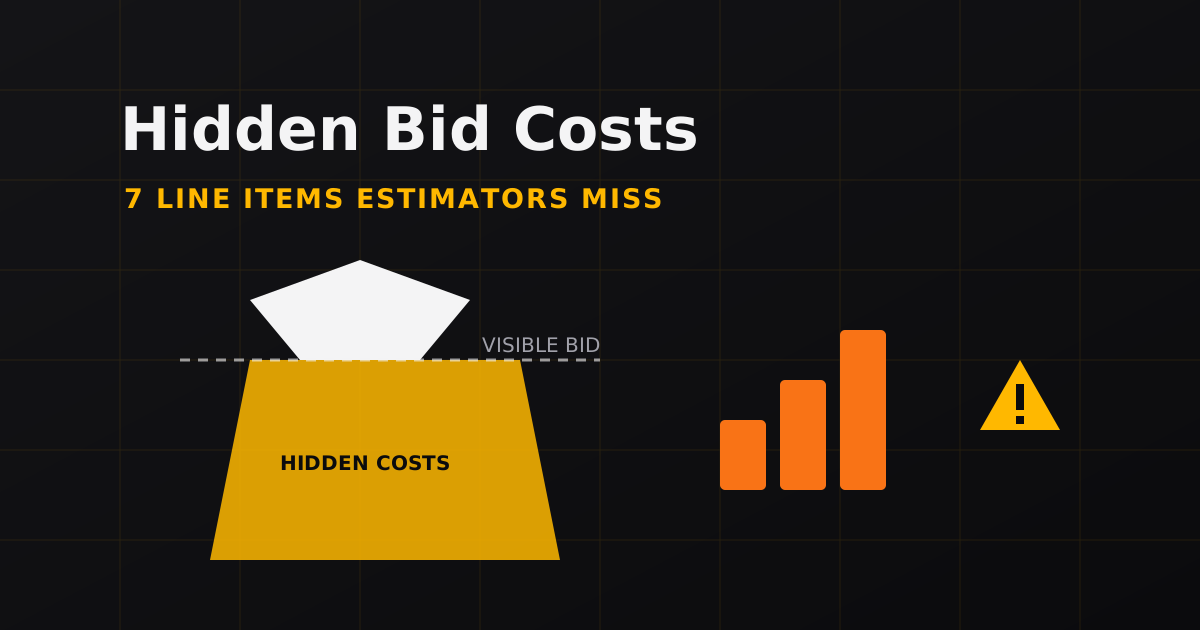
Below are seven costs that quietly sink bids, why each is so easy to miss, and — more importantly — the repeatable method that stops you missing them.
The seven usual suspects
- Soil testing. Skipping the geotechnical report doesn’t remove the risk; it transfers every future foundation problem onto you. A soil test is cheap relative to a failed footing.
- Utility connection fees. Water, sewer and electrical hookups are billed by the utility, not your suppliers, so they slip past a materials-focused take-off entirely.
- Debris removal and dumpster rental. Every project generates waste, and a single remodel can fill several containers over its life. Disposal is a recurring cost, not a one-off.
- Temporary power and site services. Framing and early trades often run before the permanent supply is energised, which means temporary power, water and sanitation on site.
- Tax on materials. Depending on the jurisdiction and whether you hold a resale exemption, sales or value-added tax can add a meaningful percentage to the material bill.
- Change-order and contingency buffer. Work without a contingency line is work bid on the optimistic assumption that nothing will go wrong. Something always does.
- Warranty-period labor. The obligation to return and fix defects during the warranty has a real cost. Most estimators carry it in overhead; the mistake is carrying it nowhere.
Why these get missed
Notice the pattern: almost every item is an indirect or site cost — something that is not part of the finished building. Estimating instinct focuses on what you can see in the drawings: walls, floors, finishes. The costs that live between the lines — getting power to the site, getting waste off it, covering the risk of the unknown — have no drawing to prompt them, so they depend entirely on memory. And memory fails under deadline pressure.
Construction planning insights
The fix is structural, not heroic. Split every estimate into direct costs (materials, labor and equipment tied to the physical work) and indirect costs (site setup, services, disposal, fees, tax and contingency). Give indirect costs their own dedicated section that you complete on every bid, no matter how small. A line that is always there cannot be forgotten; a line you have to remember, eventually will be.
- Estimate by phase. Walk the job mentally from site clearance to closeout. Each phase surfaces its own indirect costs.
- Separate contingency from padding. Contingency is a disclosed, deliberate allowance for uncertainty. Padding is a hidden fudge factor. Clients trust the first and resent the second.
- Price the warranty obligation. Even a modest percentage of contract value, carried in overhead, keeps callback costs from eating next year’s margin.
Formula: contingency done right
Contingency is a percentage applied to the estimated cost base, sized to the project’s uncertainty:
Contingency = Subtotal × (Contingency % ÷ 100)
For reasonably well-defined new work, 5–10% is a common range; renovation and projects with significant unknowns justify more. The key discipline is that contingency covers uncertainty within the defined scope — it is not a slush fund for new scope, which should always flow through a change order. See the Contingency and Subtotal references in the Formula Library for exactly how these roll into the total.
Global construction standards
The specific hidden costs shift by market, but the discipline is universal. Tax treatment varies — sales tax, GST or VAT, and whether you can reclaim it — so confirm the local basis before applying a rate. Utility and connection charges are set by local providers and can differ dramatically between neighbouring jurisdictions. Waste-disposal regulation, and therefore cost, is tightening across most developed markets. Wherever you work, the estimate that separates direct from indirect costs and carries an explicit contingency will travel better than one built on the visible work alone. The Country Guides and Knowledge Center Building Cost Guide add regional context.
Professional tips
- Keep a master checklist. One list, applied to every bid, structured by phase plus an indirect-costs section. It is the single highest-leverage estimating tool you own.
- Do a post-mortem on every job. Compare estimated against actual and feed the surprises back into the checklist. Your checklist should get smarter with every project.
- Make contingency visible. A disclosed contingency line signals professionalism; a padded unit rate signals the opposite.
- Never bid scared. If you find yourself shaving indirect costs to hit a number, you are converting a pricing problem into a delivery problem. Walk away or re-scope instead.
Frequently asked questions
What is the most commonly forgotten cost?
Site-related indirect costs — soil testing, utility connections, debris removal and temporary power. They are easy to miss because they are not part of the finished building, yet they are unavoidable and often decisive on a tight bid.
How large should a contingency be?
Around 5–10% of the subtotal for well-defined work, higher for renovation or high-uncertainty projects. Contingency covers uncertainty within scope; new scope belongs in a change order.
How do I stop forgetting line items?
Apply a standard checklist to every bid, structured by phase with a dedicated indirect-costs section. A checklist turns unreliable memory into a repeatable process.
Conclusion
Winning bids and profitable jobs are not the same thing, and the gap between them is usually a short list of forgotten line items. Build a checklist, separate direct from indirect costs, disclose your contingency, and run a post-mortem on every job so the list keeps improving. Do that and the costs that used to sink your bids become the costs your competitors forget — and you don’t.
Bid with every cost in view
Add direct and indirect line items, set a clear contingency, and let ConstrCalc total it honestly.
Related articles
Related calculators & tools
- Construction Cost Calculator — capture direct and indirect costs in one estimate.
- Compare Estimates — see the margin impact of a missing line.
- Popular Calculators — quick tools by project type.